🇫🇷 FR

The Matilda Effect

Portrait of Margaret W. Rossiter
Margaret W. Rossiter, American historian of science

When science forgets its pioneers

Behind great discoveries, female researchers have been erased, ignored or dispossessed of their work. An insidious mechanism that questions our collective memory and our relationship with recognition. Phenomenon theorized by historian of science Margaret W. Rossiter
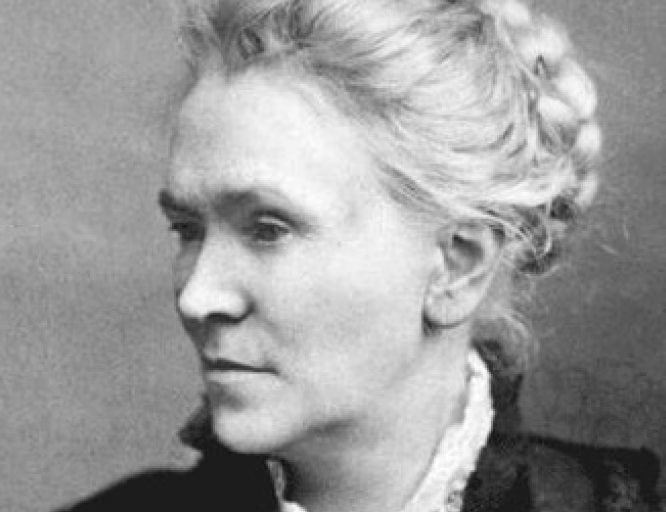
Matilda Joslyn Gage
Matilda Joslyn Gage, 19th century photograph

Long-invisibilized women

The history of science includes many women whose discoveries have been minimized, attributed to men or forgotten.

In 1993, American historian Margaret Rossiter named this phenomenon the Matilda Effect, in honor of Matilda Joslyn Gage, a 19th-century feminist activist who already denounced the erasure of women in historical narratives.

READ MORE

A structural injustice

Unlike the Matthew Effect, which favors already famous scientists, the Matilda Effect reveals a structural injustice: women are deprived of the scientific recognition they deserve. This bias manifests itself through scientific publications, prize attribution, textbooks and even official speeches, including during Nobel Prize ceremonies.


Nobel Article
Article: When science refuses to award Nobel Prizes to women

Rehabilitation and memory

A memory to rebuild

Their stories, long relegated to the margins, are now being rehabilitated through exhibitions such as the CNRS Occitanie Ouest, which offers free educational resources to make these pioneers known.

Exhibition
Exhibition hosted by Maison des Citoyens in collaboration with CNRS West

The Matilda Effect is not a simple accident of history, but the symptom of a patriarchal system that runs through scientific institutions. It questions our relationship to memory, research and the culture of recognition. It invites us to rethink the criteria of legitimacy, to value invisibilized paths and to build a more inclusive history of science.

Forgotten Women

In the scientific field

11th century
Trotula
Trotula
Gynecology

Pioneer of medieval gynecology, she wrote treatises on women's care.

1815/1852
Ada Lovelace
Ada Lovelace
Programming

First computer algorithm, long attributed to Charles Babbage.

1854/1923
Hertha Ayrton
Hertha Ayrton
Physics

Studies the electric arc and waves in fluids, first woman to present her work to the Royal Society.

1862/1935
Agnes Pockels
Agnes Pockels
Chemistry

Founder of surface science.

1878/1968
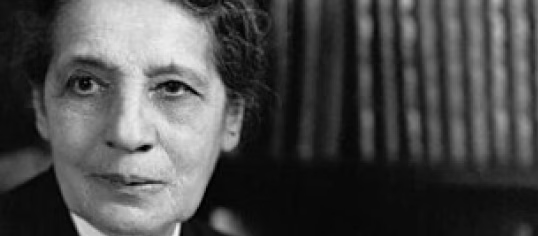
Lise Meitner
Lise Meitner
Nuclear physics

Co-discovers nuclear fission with Otto Frisch, but is excluded from the Nobel awarded to Otto Hahn.

1893/1973
Frieda Robscheit-Robbins
Medicine

Co-author of research on the treatment of pernicious anemia by liver.

1896/1957
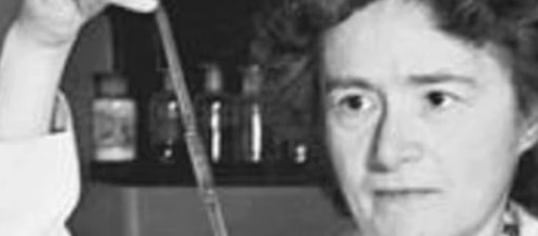
Gerty Cori
Gerty Cori
Biochemistry

First woman to receive the Nobel Prize in Medicine (1947), for her work on glucose metabolism.

1920/1958
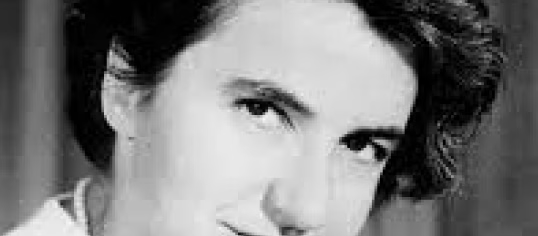
Rosalind Franklin
Rosalind Franklin
DNA

Her X-ray images reveal the double helix structure of DNA.

1924/2016
Ruth Hubbard
Ruth Hubbard
Biochemistry

Specialist in the biochemistry of vision, she is the first tenured woman in biology at Harvard.

Born in 1943
Jocelyn Bell Burnell
Astrophysics

Discovers the first pulsar in 1967, but her thesis supervisor receives the Nobel alone.

1946/2013
Candace Pert
Candace Pert
Neurobiology

Discovers opioid receptors and neuropeptides.